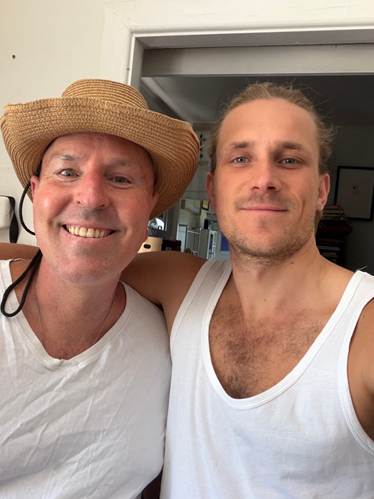
I have long had an interest in all things about mortality and even when I was 17 in high school, I made a big crayon drawing on board titled: Contemplating Death (1999) and it had a portrait of me as an old man with many wrinkles in a church with a stain glass window behind me.
However, even now after years of drawing and essays about spirituality I am not sure what happens when you die but I mainly think you only get one life and there is no afterlife but I also believe in the teachings of the saints Mary MacKillop and Saint Francis and also studied the teachings of the Dalai Lama so I am not an atheist either.
“Abandon your notions of the past, without attributing a temporal sequence! Cut off your mental associations regarding the future, without anticipation! Rest in a spacious modality, without clinging to [the thoughts of] the present. Do not meditate at all, since there is nothing upon which to meditate. Instead, revelation will come through undistracted mindfulness — Since there is nothing by which you can be distracted.
Padmasambhava,”
The Tibetan Book of the Dead. First Complete Translation
I love this Tibetan Book of the Dead quote and what I take from it is the importance of mindfulness and living in the moment.
“In Tibetan Buddhist culture, mortality is not viewed as a final end, but as a critical, natural transition point within the ongoing cycle of existence, or samsara. Death is considered a “moment of transition” or a bardo—an intermediate state between death and the next rebirth, lasting up to 49 days. Because the state of mind at the time of death directly influences the nature of the next life, Tibetan Buddhism focuses heavily on dying with awareness, calmness, and lack of attachment.”
I think this quote about Tibetan Buddhism is important as it reminds me of my mums passing and I heard she died peacefully in her sleep and I can imagine with a relaxed smile on her face before she fell asleep. I was at the airport in Rome when she died but before I went on holiday, I visited Sydney for about a week in her nursing home and had hours of reflection and talks about our lives largely around our favourite international trips.
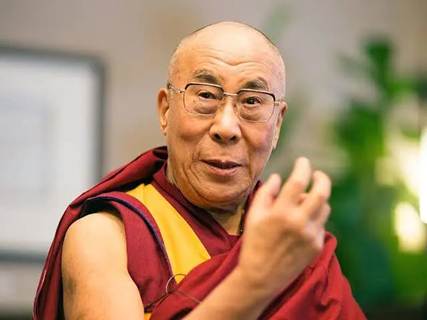
“As a Buddhist, I view death as a normal process, a reality that I accept will occur as long as I remain in this earthly existence. Knowing that I cannot escape it, I see no point in worrying about it. I tend to think of death as being like changing your clothes when they are old and worn out, rather than as some final end. Yet death is unpredictable: We do not know when or how it will take place. So, it is only sensible to take certain precautions before it actually happens.”
Dalai Lama
This Dalai Lama quote is fascinating and I love the idea of when you die that there is a next life and it’s just like changing clothes but I don’t agree with this idea myself. I also agree that you never know when or how you are going to die which horrifies me as I want to live a long life to a ripe old age as there is so much I want to do with my art and writing and I love life so much.
“We cannot hope to die peacefully if our lives have been full of violence, or if our minds have mostly been agitated by emotions like anger, attachment, or fear. So, if we wish to die well, we must learn how to live well: Hoping for a peaceful death, we must cultivate peace in our mind, and in our way of life.”
Dalai Lama
I agree with the Dalai Lama that in my own life to eventually die well I need to live well with as much positive emotions and never look sideways at anyone and if I do accidentally then apologise as soon as possible.
“From a Buddhist point of view, the actual experience of death is very important. Although how or where we will be reborn is generally dependent on karmic forces, our state of mind at the time of death can influence the quality of our next rebirth. So, at the moment of death, in spite of the great variety of karmas we have accumulated, if we make a special effort to generate a virtuous state of mind, we may strengthen and activate a virtuous karma, and so bring about a happy rebirth.”
Dalai Lama
I love this Dalai Lama quote and find it profound but I also find solace in the idea that one of the Dalai Lama’s closest friends was Desmond Tutu from South Africa who was a Christian and they accepted that they had very different spiritual beliefs but also many similarities too. I also love how they used to tease each other gently like all close friends do.

“What makes you purr? … It’s the deep-down happiness that makes you purr from the heart”.
David Michie
I love this David Michie quote and I feel I am kind of a cat as I don’t stray far from home literally or metaphorically.
“Marina Abramović has frequently explored themes of mortality, death rites, and the Buddhist concept of impermanence, particularly through her 1995 work Cleaning the Mirror #1 and her 200: piece Nude with Skeleton. These performances were influenced by Tibetan Buddhist practices, specifically the tradition of meditating alongside decaying corpses to overcome the fear of death.”
Key performances related to Marina Abramović’s theme include:
“Cleaning the Mirror #1 (1995): A three-hour, five-monitor video installation where Abramović sits with a human skeleton on her lap, vigorously scrubbing it with soapy water. As she cleans the bones, her own body becomes covered in the filth, symbolizing a meditative, intimate confrontation with death and the preparation for one’s own mortality.
Nude with Skeleton (2002/2003): Inspired by Tibetan monks who sleep beside corpses, this performance involved Abramović lying naked on the gallery floor with a human skeleton resting on top of her. The work emphasized the connection between the living and the dead, with the skeleton’s movements animated by her. “
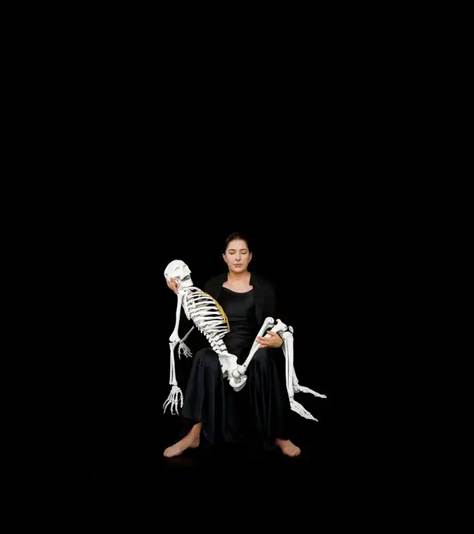
I don’t feel I could cope with this Tibetan tradition of nursing a decaying corpse to deal with all human’s mortality as when my best friend died at 17 in my first week of art school, I didn’t go to see his body as I wanted to remember him the way he was when he was alive always smiling, full of life and so funny.

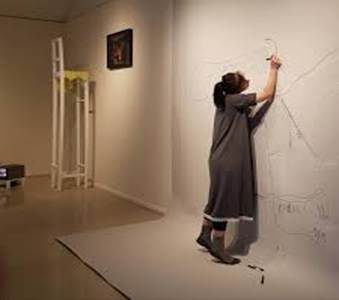
“Katthy Cavaliere was known for her performance art and installations inspired by the everyday. She also worked with photography, using the medium to record and encapsulate her performances and installation-based works in compositions that endure beyond the initial ephemeral events. Like many of her later works, ‘Afterlife’ deals with the death of her mother and the intense grief she experienced in the years that followed. A poetic and personal portrait, this photograph shows a large hand-blown hourglass filled with Cavaliere’s mother’s ashes. Behind it is the artist’s shadow. This work explores the bond between mother and daughter while also symbolising death, loss and the passing of time.”
Katthy was a close friend of mine before she passed age 39 and achieved a lot in her short life. She studied under the artist Marina Abramović as an art mentor and this had a great deal of influence on her own photography, installations and performance art. Katthy left a legacy in the form of a scholarship for Australian female performance and installation artists. She playfully changed the spelling of her first name from Kathy to Katthy.
In conclusion I feel that meditating on my own mortality makes me live in the moment more and I try to do everything to stay alive as long as possible by exercising and watching my physical and mental diet. I enjoy life a lot and have a lot I want to do with my art and writing and enjoy friendship with my friends.